Sunday, 29 July 2018

Pawn shop buys violin for $50, finds out it’s worth $250,000

SOMERVILLE, Mass. (AP) — A violin bought by a Massachusetts pawn shop for $50 has ended up being worth about 5,000 times that.
WFXT-TV reports a new employee at the LBC Boutique and Loan in Somerville had no idea what he was buying when he paid for the Ferdinando Gagliano violin, which was handcrafted in 1759 and is worth $250,000. Store manager Dylan McDermitt says the bows alone are worth $16,000 to $18,000.
Police say the violin was stolen during a house break-in and has since been returned to its rightful owner. They say the seller had no criminal record and they’re still investigating.
McDermitt says in the future shop employees are going to ask people who bring in violins to play them so they know the instruments are theirs.
___

Saturday, 28 July 2018

This Columbia Professor Allegedly Told His Coworker He Was “Horny” And Tried To Kiss Her. A Jury Said It’s Not Sexual Harassment.

Enrichetta Ravina took the extremely rare step of taking professor Geert Bekaert and Columbia University to trial in federal court for gender discrimination and retaliation — one of the first such cases in the #MeToo era.

Professor Enrichetta Ravina visited her colleague, professor Geert Bekaert, at his Columbia Business School office in the spring of 2014 hoping to talk about their joint research project she felt was dragging along.
In his office, Ravina said that Bekaert, a professor of finance, asked her to pick up and look at a mug sitting on a shelf next to a framed photo of him and his daughters in Central Park.
The chipped, white mug had a goatlike creature with large horns on the front and the words, “I’m cultured, refined, sophisticated, and…”
Ravina said Bekaert told her to look on the bottom. It read: “horny.”
Ravina was surprised. She looked up at Bekaert, who, she said, laughed and proclaimed, “It’s true.”
Bekaert said this exchange never happened.
“I grew concerned that he wanted more than a professional relationship. He wanted a romantic relationship.”
Ravina testified in court that the professor, who has tenure and was secure in his job but wasn’t her boss, was relentless. He invited her to private dinners, talked about his sex life, and once tried kissing her against her will. When she rebuffed him, she said Bekaert retaliated by delaying their joint research and disparaging her to top finance academics — ultimately tanking her chances at tenure, which would have provided her with job security for life.
She filed a harassment and retaliation report to Columbia University administrators, who she said botched their investigation and did little to protect her from Bekaert.
So Ravina filed a gender discrimination civil lawsuit for sexual harassment and retaliation in 2016 against Bekaert and Columbia — and in an extremely rare move, took it to trial over the past three weeks. It’s one of the first such cases since the rise of the #MeToo movement.
In response, Bekaert sent emails to editors of finance journals and business professors around the world. Revealed in court, those messages — to people he calls his friends and former students — called Ravina “sick,” “crazy,” “evil,” and a “bitch.”
The details of the federal case in Manhattan didn’t take off on social media. There weren’t shocking, Harvey Weinstein–type accusations. Experts told BuzzFeed News the #MeToo movement — where sometimes scores of women, supported by meticulous corroboration, would accuse a man of stunning sexual misconduct — may have even “raised the bar” for what a jury could consider sexual harassment.
And to Ravina, that is exactly the point: She said she was a victim of the subtle and persistent harassment that countless women experience every single day in the workplace.
It was a “he said, she said” case. Ravina said she suffered personally during the harassment and professionally after. Bekaert said none of Ravina’s allegations are true, he was never romantically interested in her, and that he’s being scapegoated for her poor work. Each side said the exact same words in the exact same emails proved their own case.
So it was up to a jury of four men and four women to decide: Was Enrichetta Ravina sexually harassed? Was she retaliated against for daring to file a complaint? Or was she just reading it all wrong?
Enrichetta Ravina
Ravina was recruited to Columbia Business School from New York University in 2008 as a tenure-track assistant professor. She focuses on household finance.
When she arrived, Bekaert approached her about working together to analyze a massive data set he obtained. The research, he told her, could culminate into several papers about people’s saving habits that could be published in top journals.
Bekaert, nicknamed “the blunt Belgian,” is very successful. He’s been published in prestigious journals, he’s consulted with international companies, and he’s presented at some of the most important conferences in the financial industry. Through his decades-long career he’s made connections at the best business schools and top publications around the world.
It was a potentially career-making opportunity for Ravina. She knew she needed to publish more to be seriously considered for tenure.
By the summer of 2012, when they received most of the data, Ravina said Bekaert’s previously professional behavior turned “weirdly personal.”

Columbia University
On July 31, 2012, he sent her an email saying, “Just keeping tabs on you. If you finish revision, I will pay for dinner at my local Italian restaurant with the Torino owner … Shoot. Maybe you will not want to finish then.”
Ravina said he repeatedly invited her to this restaurant because the owner was from the same Italian city she was. She didn’t want to go, so she came up with excuses, like saying she had already eaten dinner or that she was on a diet.
But the invitations kept coming. Eventually, she said, she ran out of excuses and agreed to a dinner in September 2012. They waited for a table at the bar.
Bekaert started “asking me if I have a boyfriend, if I lived with my boyfriend, because someone told him that I was living with my boyfriend,” Ravina testified. “I was so shocked by the question that I just blurted out the truth, and said, no, I wasn’t living with my boyfriend. I didn’t have a boyfriend.”
They shared a cab back to their apartments. When the car stopped at a corner and Ravina turned to exit, she said Bekaert passed his hand over her lower back and went toward her butt.
“My stomach churned. I grew concerned that he wanted more than a professional relationship,” she testified. “He wanted a romantic relationship.”
Worried that Bekaert might feel rejected — and not wanting to jeopardize their work — she sent him a note thanking him for dinner.
“I couldn’t afford to offend him. I was walking a tightrope.”
Later that semester, Ravina said Bekaert sent her songs and albums with titles such as “Love Is the Drug” and Sad Songs for Dirty Lovers.
By the next semester, spring 2013, Ravina said the research was progressing well. Bekaert was on sabbatical in Hong Kong, and when he visited New York for a week that April, they met at a restaurant in the Lower East Side to discuss their work.
Ravina said Bekaert spent the entire time detailing his sex life in Hong Kong.
“My impression was that he was telling me how desirable he was,” she testified. “He was telling me that there were people after him.”
Ravina met with him again at a coffee shop near his hotel. She had just received a poor evaluation from Columbia — Bekaert played no role in it — saying she needed to publish more papers and that her chances for tenure were unlikely. She wanted to talk about it with Bekaert.
When she got there, Bekaert commented on her “sexy” walk.
She began to feel like he was withdrawing from the project, she testified, by not responding promptly to her requests and failing to send along drafts, outlines, and other information she asked for. But she didn’t outright tell him this yet.
By the fall 2013 semester, when Bekaert returned from his sabbatical, Ravina said their relationship grew increasingly unprofessional. His dinner invitations persisted, and Ravina countered by trying to make them group events. On one occasion she suggested an outing with two other colleagues to an art gallery instead.
“He was displeased,” she said. “He didn’t want to join them … He insisted to go for dinner, just the two of us.”
That September, after a private dinner, Ravina said Bekaert walked her home. As she walked up the stairs to the front door of her building, she said he grabbed her arm and pulled her toward him for a kiss. She swerved, and the kiss landed on her cheek.
“I just [said] bye and went up, ran up the stairs and entered my building,” Ravina testified.
Ravina said she never explicitly told Bekaert she did not want to go out with him. “I couldn’t afford to offend him,” she said. “I was walking a tightrope.”
The two went out for dinner again shortly after. As they sat at the bar area, Ravina said Bekaert reached over and held her hand.
“I just froze,” she said. “I didn’t say anything. I remained immobile and silent [until] he let go.”
This came during a time Ravina was increasingly nervous about their research. She said she felt they were not making enough progress. Bekaert kept telling her he was too busy.
“I think she called me an idiot one time and that’s fine." 
When she met with him discuss it, she said Bekaert would change the conversation to sex — like at a crowded coffee shop on Columbia’s campus, when Ravina said Bekaert asked her if she watched porn. Or in another meeting, when Ravina said Bekaert told her prostitutes “keep men out of trouble,” and are “important to satisfy a man’s sex drive.” He also asked her for dating advice.
Once, she said, as she tried steering the conversation back to work, she said he told her “if you were nicer to me” the papers “would move faster.”
She responded she was already as nice as she could be.
“It was as if he was sort of waiting to see if I was changing my mind, if I would sleep with him,” she said.
The spring 2014 semester rolled around. Ravina said Bekaert came to her office around Valentine’s Day with chocolate and a CD of music.
That was the semester Bekaert became aggressive, she testified. He started belittling her and her work by calling her “insane” and saying her data calculations were wrong.
Ravina started having trouble sleeping. She started experiencing back pain and gained weight. She decided to see a psychiatrist to cope with her anxiety.
She asked Bekaert, over email, to treat her professionally and with respect.
“Yes, let’s meet next week. I’ll bring a whip,” he responded.
In May 2014, she brought the situation to the school’s administrators.
A few weeks after talking to the deans, Ravina received an email in July 2014 from Bekaert, saying, “the dean’s office has told me not to talk to you, hence the silence. If you want to explain yourself, you can. I’m intrigued to know who set you up to this.”
Geert Bekaert, left, with his lawyer.
Bekaert, in his defense, said that while many of the meetings with Ravina happened, and that while many of the conversations were personal — discussing his failing marriage and her ailing mother — they were never sexual. He said she was reading it all wrong.
And when he found out about the formal complaint against him, Bekaert said he was “flabbergasted.”
He denied ever having any romantic interest in her. While the two of them went out for dinners and coffees, he never pressured her to do so, arguing she always agreed to the dinners and was often the one who picked the restaurant.
She was the “restaurant snob,” Bekaert said, and he was the “music snob.” While Ravina “educated” him on the New York food scene, Bekaert said he “educated” Ravina by introducing her to good music.
And at those dinners, not once did he discuss his sex life, he said, adding that he certainly never tried to kiss her.
“In some sense, looking back, I find it strange that we never did sort of cheek kissing, because in both our cultures, this is very normal,” he said. “I mean, where I’m from, that’s what you do, but we never did.”
Bekaert said that going out to dinner or for coffee with a coauthor is normal in the profession. When working so closely with someone, you build a friendly relationship, he said, adding that he even allowed one of his coauthors to stay at his apartment when that person was visiting New York.
Bekaert said their emails were indicative of their friendly, blunt relationship. “I think she called me an idiot one time and that’s fine,” he said.
Shortly after one of their dinners where Bekaert said they discussed movies and music, she sent him an email that ended with, “PS — I just watched a movie with Owen Wilson on the plane, and I think he’s really hot.”
As for the chocolate around Valentine’s Day, Bekaert said it wasn’t a gift — it was a freebie he was given on a flight from Brussels Airlines.
“Enrichetta came [by] for a meeting, I had that bag lying around … and I said, ‘you know, do you want the pralines? Here you go,’” he testified. A research assistant who worked with both professors testified that Bekaert would give out chocolates he had taken from planes.
And while he does have the “horny” mug in his office, Bekaert said, “there’s nothing sexual about it.” He called it a bizarre memento, a gift from his ex-mother-in-law that has become a family joke.
Bekaert argued in court that all he did was try to help Ravina further her career. He repeatedly suggested she complete and publish two papers she was individually working on from before she joined Columbia, since being a sole author on a piece carries a lot of weight when determining tenure.
It became clearer and clearer as the years went on, he said, that those papers were not being completed and her chances of tenure were diminishing.
Bekaert said he never did anything to hinder their joint research project — in fact, he said, based on his past experience working on papers he believes their work moved rather quickly.
He added that Ravina herself was the one to blame for some of the delays. In one example, he said, he “fell off my chair” when she drafted a paper they had already agreed Bekaert would write.
“This was crazy … this is your bread and butter for tenure, so to speak,” he testified in court about the dual drafts. “This is very, very risky, so I thought … this was totally crazy.”

Ravina, left, with her lawyers.
The dean of the business school, Glenn Hubbard, brought Ravina’s complaint to the university’s Equal Opportunity and Affirmative Action office. In August 2014, Ravina met with Michael Dunn, the deputy Title IX coordinator tasked with enforcing the university’s policy on sexual harassment and discrimination.
Dunn took on the investigation, one Ravina and her lawyers said was incomplete, superficial, took things out of context, and did not investigate the full scope of the situation.
Dunn interviewed just three people — Ravina, Bekaert, and a research assistant who told Dunn she was “biased” because Bekaert would soon serve on her dissertation committee and that she viewed him as a “father figure.”
The research assistant had also stopped working with Ravina and Bekaert’s joint project in 2012 — two years before Ravina filed her complaint.
Dunn testified that Ravina did not tell him about Bekaert trying to kiss her, or placing his hand on her lower back as she got out of a cab.
Dunn also testified he was he was responsible for 15 to 20 cases at a time and was overwhelmed with his workload. While the university tries to complete investigations within 60 days of the complaint, it took Dunn about four months to reach a decision.
He absolved Bekaert of any wrongdoing.
“I found that you and Professor Bekaert engaged in a friendly working relationship that soured when you did not communicate effectively.”
“I found that you and Professor Bekaert engaged in a friendly working relationship that soured when you did not communicate effectively regarding your concerns about the status of your project,” Dunn’s report, called an outcome letter, addressed to Ravina said. “I determine that your professional relationship with Professor Bekaert was friendly and at times mutually flirtatious.”
Dunn said he found Ravina and Bekaert’s exchanges to be “childish.” While the email about bringing a whip to a meeting was “obnoxious,” Dunn said he didn’t think it constituted sexual harassment. The “horny” mug was deemed inappropriate. The only recommendation Dunn made was for Bekaert to undergo communication training — a one-hour-long conversation with an outside lawyer conducted six months after Dunn’s outcome letter.
This was the second complaint against Bekaert that Dunn investigated that year. An MBA student had previously accused the professor of making a comment to the effect of “Hong Kong, where the ladies are nice” during class. The student ultimately did not want to pursue the case and dropped the complaint.
Dunn investigated four complaints of harassment at the business school in 2014. In each of the complaints, he found the male professors did not violate the rules.
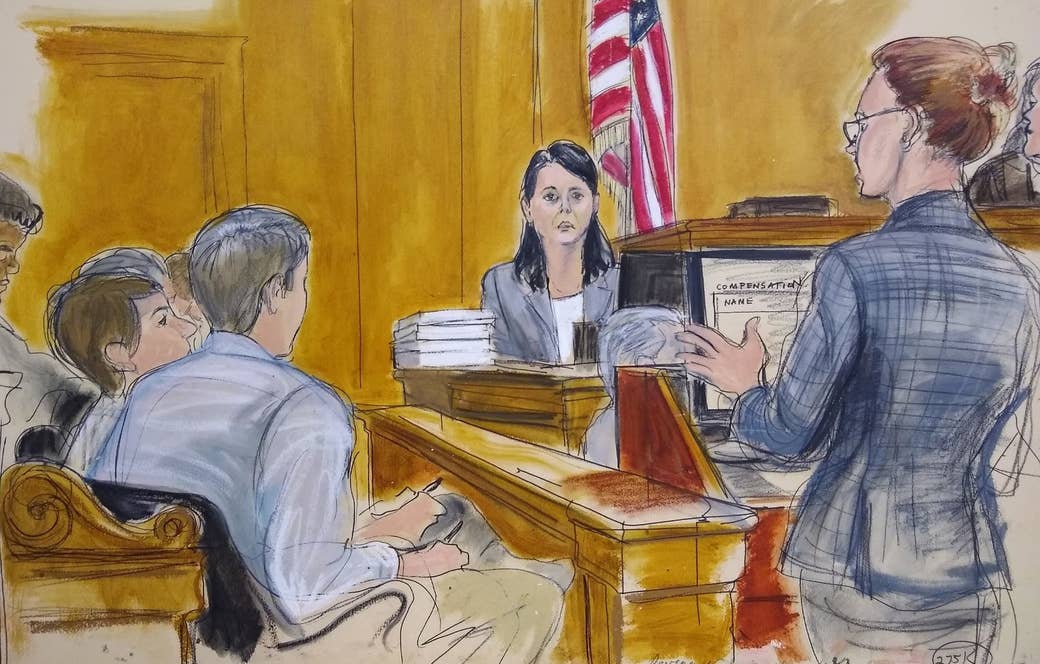
A courtroom sketch of Ravina on the witness stand.Ravina appealed the outcome of her own case. “[The investigation] ignored the fact,” she testified, “that I was a junior tenure-track professor and he was a senior professor having power on my tenure, my standing in the profession, and on the data set that was the basis of a very important set of papers in my field.”
After 12 days of testimony and almost two days of deliberations, the jury unanimously decided that, under the New York City Human Rights Law, Bekaert did not sexually harass Ravina or discriminate against her on the basis of gender.
But the jury did find that that he retaliated against her.
The jury also decided that Columbia is liable for Bekaert’s retaliation but found no wrongdoing with the university’s conduct.
The jury awarded Ravina a total of $1.25 million in damages. They found Columbia and Bekaert are liable for $750,000 in compensatory damages, including harm in reputation and emotional suffering, and that Bekaert is responsible for $500,000 in punitive damages.
The jury did not award Ravina any economic damages for loss in back pay and front pay.
Debra Katz, a DC-based sexual harassment attorney who is not involved in this case, told BuzzFeed News that civil discrimination lawsuits rarely make it to trial, and when they do, they’re very difficult to argue.
“Even in this #MeToo era, there’s so much sexism,” Katz said. “If there’s no really strong evidence, it’s hard to win a nuanced case.”
As hundreds of women across the country shared their experiences of sexual harassment in the workplace over the last eight months, Katz argued it “raised the bar” of trying cases like Ravina’s.
When the allegations in a case are not as egregious or extreme as those published in news outlets about people like Harvey Weinstein and Kevin Spacey, “you’re going to have people on the jury say, ‘so what?’” Katz said.
And Ravina herself recognized that each element of her case, by itself, may not seem like a big deal at first.
“Once you look at all these instances and then the climate that they were creating, their evolution over time,” she testified, “becoming more and more aggressive, abusive, and harassing — I think this gives you the whole picture of what happened.”
Carrie Goldberg, a New York City attorney who argues cases of harassment and sexual assault, said that although the #MeToo movement made a part of the country “a hair more informed” about how often women are harassed in the workplace, she said “most people still haven’t gotten the memo.”
“Because what we’re really talking about is not the courts, but the mores of our society,” Goldberg said. “#MeToo is a slender correction of bias."

In the end, Ravina and Bekaert agreed on one thing: They both suffered greatly at each other’s hands.
By the spring 2015 academic semester, realizing she was not on a good track for tenure, Ravina began having conversations with business school administrators about going on leave for one year to make up for lost time.
The university instead offered she stay on as an “associate research scholar” to extend her tenure review — a position Ravina rejected, calling it a demotion that would reflect poorly in the academic community.
And in spring of 2016, a committee comprising senior faculty at the business school — not including Bekaert — rejected Ravina’s tenure application, meaning she had to leave Columbia the following year.
Bekaert said that when Ravina filed her lawsuit and spoke to the press, including the New York Times, he was cast as a villain and his reputation was irreparably damaged.
“I really mean that what Enrichetta has done to me is pure evil.”
“Lots of people, you know, friends were contacting me about this,” he testified, breaking down in tears on the stand. “And for good measure, it was in Poets & Quants, which is a magazine that MBA students read. All this stuff was out there. I mean, the next week I had to go teach … how do you tell your students about all this stuff?”
Ravina also testified her reputation and career were damaged when Bekaert engaged in the emailed “smear campaign.” Finance academia is a small world, she said, where everyone knows everyone and “rumors fly fast.” Ravina said she’s felt like an outcast in the community and someone whom others would find difficult to work with.
Bekaert’s emails calling Ravina an “evil bitch” were sent, among others, to a professor at the University of Sydney Business School in Australia, and another professor who was at the time at Purdue University and is now an associate editor at the Journal of Banking and Finance.
Bekaert also emailed the former president of the American Finance Association, a member of the Federal Reserve Board of Governors, as well as the company that gave them the data set they analyzed, calling Ravina “sick” and “crazy.”
Bekaert said he was trying to defend himself at the time but realizes his communication skills can be better. He testified that he regrets some things he wrote in some emails to Ravina, such as calling her “crazy,” but showed little remorse for calling her “evil.”
“I really mean that what Enrichetta has done to me is pure evil,” he said. “This is — this is the worst thing that ever happened in my life in terms of somebody doing something to me … to sort of use my status in the profession and my position at Columbia and basically destroy my career with a bunch of lies, I think this is pure evil.”
Ravina’s career has been derailed. She’s currently a visiting assistant professor at Northwestern’s Kellogg School of Management. The position is temporary and expires next June, and she doesn’t know what’s next.
She’ll join the job market this fall, she said, and will likely only be hired by a school with a lower ranking than Columbia.
“I knew in abstract, in theory, that discrimination is bad,” she testified. “Once I was subjected to discrimination, I understood on a whole new level how devastating this can be.” ●

Louisiana woman abused, forced to eat mother's ashes by 5 relatives, indictment describes


A Louisiana woman living with autism was locked up in a cage, threatened and abused and forced to eat her mother's ashes by five people, who were indicted this week by a federal grand jury in New Orleans, officials said.
The indictments accuse five family members of abusing their 22-year-old relative until June 2016, according to court documents released by the U.S. District Court for the Eastern District of Louisiana.
Raylaine Knope, Terry J. Knope II, Jody Lambert, Taylor Knope and Bridget Lambert were identified Thursday in the indictment. Bridget Lambert was charged separately in the investigation.
The story first came to light in July 2016, when the Tangipahoa Parish Sheriff's Office announced it had arrested the five for holding the victim against her will. The details about the investigation were only recently revealed in the federal indictment.Investigators said the victim, whose identify was not fully revealed, was a relative of Raylaine Knope and came under her care in August 2015, when the victim's mother died.
According to court documents, the abuse happened at a home on Rushing Lane in Amite. The victim is diagnosed with disabilities, including autism, officials said.
Raylaine Knope is accused of directing most of the abuse, while Terry Knope become the representative payee of the victim's Supplemental Security Income benefits, which are provided to people who are disabled and have little to no income.
Terry Knope became the beneficiary of the victim's benefits soon after her mother died.
According to federal investigators, some of the crimes the five conspired to included threatening the victim with force, causing her harm and making her work against her will.
The indictment goes into detail about the allegations against the suspects, specifically identifying Terry Knope, Raylaine Knope, Jody Lambert and Taylor Knope for making the victim perform house and yard work for the family.
"The plan of the conspiracy was for the co-conspirators to subject (the victim) to physical violence, threats of physical violence, psychological and verbal abuse, abuse of legal process and psychological manipulation to obtain uncompensated labor and services from (the victim)," officials alleged in the indictment.
Federal investigators said the victim was initially allowed to sleep inside the family's mobile home on a mattress on the floor, but then Raylaine Knope ordered her to sleep in a tent outside in the backyard.
The tent was locked at the zipper and Raylaine Knope ordered her relatives to secure the victim inside at night so she would not escape, officials said.
The victim slept in the tent until she tried to escape, officials said. Raylaine Knope allegedly threatened to kill the woman if she ever tried to escape again.
Soon after, the tent the victim slept in was moved into a shed with a padlock, the court documents describe. That was until Raylaine Knope allegedly told Terry Knope and Jody Lambert to build a cage for the woman, which was made of chicken wire and covered with a plastic tarp and tree branches, officials said.
Court documents allege the victim was required to live in the cage when she wasn't working for the family. Some of the work she was required to do was clean the trailer with a toothbrush, cut the grass with scissors and clean the septic system without gloves, tools or protective clothing, officials said.
Raylaine Knope is accused of withholding food from the victim if she did not complete her work or did not do it fast enough, the documents allege.
Investigators said some of the harm done to the victim included Terry Knope smashing her hand with a hammer, shooting her with a BB gun and burning her hand with a lighter, when Bridget Lambert is accused of holding the victim's hand in place.
During one instance of abuse, the investigators said they learned Raylaine Knope ordered the victim to open her mother's urn, pour the ashes into a bowl and eat them with a spoon as Raylaine Knope, Terry Knope, Jody Lambert and Taylor Knope watched.
The victim was also ordered to take off her clothes and make sexual advances to men who came to the mobile home, including a repairman and a family friend, officials said.
Investigators said Raylaine Knope and Terry Knope forced the victim to use meth and prescription painkillers and threatened to turn her in to police for using drugs if the victim did not obey their orders.
The abuse continued until June 2016, investigators said.
Federal officials said the forced labor, forced labor conspiracy and Fair Housing Act charges against Raylaine Knope, Terry Knope, Jody Lambert and Taylor Knope carry a statutory maximum penalty of life imprisonment. The four also face prison time for sex trafficking and theft of government funds if convicted.
Bridget Lambert could serve at least five years in prison on her charges if convicted, officials said.
Officials said the case was investigated by the FBI in New Orleans.

Business tax payments plunge, while workers pay more

Workers are shouldering a rising share of federal revenue, while tax payments by businesses are plunging toward record lows.
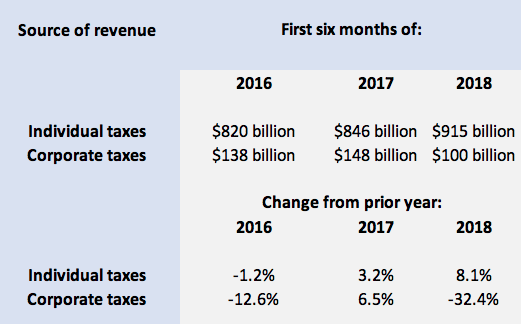
Treasury Department data for the first half of 2018 show individual income tax receipts rose 8.1%, to $915 billion. Corporate income tax receipts fell 32.4%, to $100 billion. The sharp decline in corporate tax revenue is largely a result of the tax cuts President Trump signed into law at the end of 2017, which cut the top corporate rate from 35% to 21%. Here are the numbers:

The drop in corporate tax payments isn’t surprising, since that’s exactly what the Trump tax cuts were designed to do: leave more after-tax income in corporate coffers to spur more investment. Workers got tax cuts too, but they were relatively modest. About two thirds of households got a tax cut averaging about $2,200, according to the Tax Policy Center. Taxes will rise for 6% of households, by an average of $2,800. The rest should see no change.
Demonstrators against the Republican tax reform bill hold a “Peoples Filibuster to Stop Tax Cuts for Billionaires,” protest rally outside the US Capitol on Capitol Hill in Washington, Nov. 30, 2017. (Photo: Saul Loeb/AFP/Getty Images)
Corporate tax receipts have steadily declined as a portion of all federal revenue, from 17% in 1970 to 9% last year. So far in 2018, corporate tax receipts represent just 5.6% of federal revenue, which is the smallest portion ever on an annualized basis. (Statistical note: The government’s fiscal year starts in October, so FY 2018 tax revenue will include three months without the Trump tax cuts and nine months with them. The 5.6% figure above is just for the first six months of calendar year 2018, when the Trump tax cuts were fully in effect.)
Here’s how the makeup of federal tax revenue has changed over time. Not shown are social-welfare taxes, excise taxes and other sources of revenue:
It’s not surprising that tax payments from individual workers would rise this year, even with a tax cut in effect. Inflation, wage growth and other factors normally push tax payments from workers higher when the economy is growing.
Last summer, the Congressional Budget Office (CBO) forecast that, without any tax cuts, individual tax receipts would rise 9.5% in 2018. The smaller rise of 8.1% could reflect the impact of the Trump tax cuts. And most workers didn’t see lower tax withholdings in their paychecks until March, at the earliest, which means the full effect of the tax cuts aren’t showing up yet in government revenue numbers.
The CBO expected corporate tax revenue to rise 4.5% this year, without any tax cuts. The huge drop in corporate tax revenue, following the tax cuts, highlights why the tax law has become a political problem for Trump and his fellow Republicans. The tax law is unpopular, with 43% of Americans disapproving and just 36% approving, in the Real Clear Politics average of polls. Americans in general feel the tax cuts too heavily favor businesses and the wealthy — and the federal revenue numbers bear that out. The unpopularity of the tax cuts could lead voters away from Republicans in the upcoming midterm elections, and perhaps tip one or both houses of Congress to Democrats.
The Trump tax cuts are also ballooning Washington’s annual deficits, along with the national debt. The CBO expects the gap between revenue and spending to soar by 21% this year, to $804 billion. The deficit will exceed $1 trillion by 2020 and grow for the foreseeable future.
Trump and a few sympathetic economists say the tax cuts will stimulate so much growth that federal tax revenue will eventually be higher than it would be without any tax cuts. Most budget experts disagree. “The federal government will certainly collect less revenue than it would have without the tax cut,” says economist Kyle Pomerlau of the nonprofit Tax Foundation. “Eventually, the government does need to pay its bills. We’re not on a sustainable path.”

Woman, her two great-grandchildren found dead in California fire

REDDING, Calif. (Reuters) - Human remains believed to be that of a missing elderly woman and her two great-grandchildren were found at a home destroyed by a monster wildfire raging in Northern California, officials said on Saturday, raising the death toll from the blaze to five.
The three bodies have yet to be positively identified. But news of their discovery, confirmed by the Shasta County sheriff, came as some 3,500 firefighters struggled through a sixth day to corral fierce, erratic flames stoked by tinder-dry vegetation, high winds and triple-digit temperatures.
The Carr Fire has charred nearly 84,000 acres (34,000 hectares), an area nearly three times the size of San Francisco, since erupting on Monday near Redding, a city of 90,000 people about 160 miles (260 kms) north of the state capital Sacramento.
The blaze was one of about a dozen major wildfires burning across California on Saturday and of nearly 90 overall from Texas to Oregon.
Driven by gale-force winds Thursday night, it exploded into a firestorm that leaped the Sacramento River and engulfed whole neighborhoods in and around Redding, sending thousands of people fleeing for their lives in a chaotic evacuation.
A private bulldozer operator on the fire line and a Redding firefighter were killed in the conflagration. The nearby town of Keswick, with a population of about 450, was reduced to ash.
Some 500 structures were destroyed, and 38,000 people remained under evacuation orders as of Saturday, according to the California Department of Forestry and Fire Protection.
On Saturday afternoon, Redding police said they were trying to locate 17 people reported missing by relatives or friends since Thursday night. Police Sergeant Todd Cogle said the number of those unaccounted for had fluctuated during the past two days - from as many as 20 to as few as 12 - as some who were reported missing turned up safe and others were added to the list.
Counted among them were the three victims whose bodies officials said were found at an incinerated home on the outskirts of Redding.
'I WAS TRYING TO GET TO THEM'
The Sacramento Bee newspaper said family members identified the dead as 70-year-old Melody Bledsoe, and her two great-grandchildren, James Roberts, 4, and Emily Roberts, 5.
The children's mother, Sherry Bledsoe, was quoted by the newspaper as saying, "My kids are deceased, that's all I can say," as she left the sheriff's office on Saturday.
According to the Sacramento Bee account, Melody Bledsoe's husband, Ed Bledsoe, wept as he recalled trying to get back to the family's house after he had left to run an errand on Thursday, only to learn that the fire was closing in on them. He told the newspaper that he spoke to the children on the phone as he raced in vain to return in time to save them.
"I talked to them until the fire got them," he was quoted as saying. "I was trying to get to them, I was trying to get to the fire."
Sheriff Tom Bosenko declined to provide details about the three deaths. At a community meeting in Redding late on Saturday, he told Reuters, "There were three confirmed fatalities at that location."
So far this year, wildfires have scorched almost 4.3 million acres (1.7 million hectares) across the country, less than last year but still higher than the 3.7 million-acre (1.5 million-hectare) average for the same period over the last decade. California has been particularly hard hit with several fierce blazes menacing large populated areas.
One of those, the Cranston fire, prompted a rare closure of much of Yosemite National Park last week, while another forced mass evacuations from the mountain resort community of Idyllwild east of Los Angeles.
Fire officials said the Carr Fire in particular has burned with an "unprecedented" intensity and unpredictable progression that has confounded them.
As of Saturday night, ground crews backed by a squadron of 17 water-dropping helicopters had managed to carve buffer lines around just 5 percent of the fire's perimeter, leaving the blaze largely unchecked.
At a community meeting in Redding, fire command spokesman Rick Young said 150 fire engines had been newly deployed to the blaze, many from out of state. National Guard troops also were called in to assist at roadblocks.
"We have experienced a lot of looting in these evacuation zones," Redding Police Chief Roger Moore said, adding that police had made at least one arrest and were searching for several other suspects.
(Writing and additional reporting by Steve Gorman in Los Angeles; Additional reporting by Bernie Woodall in Fort Lauderdale, Fla., Scott Malone in Boston and Brendan O'Brien in Milwaukee; Editing by Sandra Maler and Richard Pullin)

5 kids and their mom die in Michigan motel fire


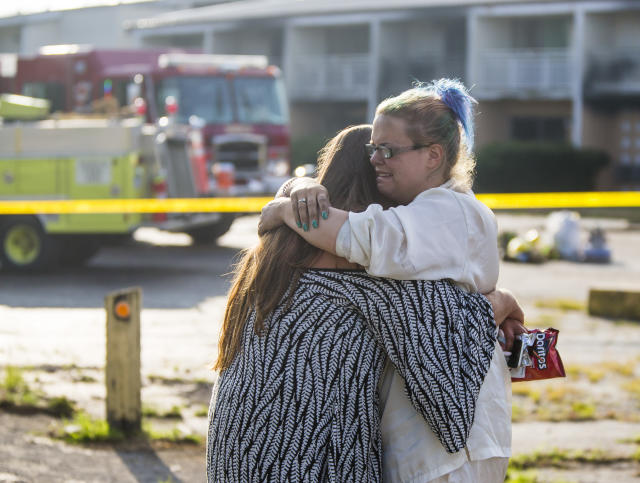
Hotel residents Cassundra Clements, left, and Sarah Sanders comfort one another after a fire at the Cosmo Extended Stay Motel in Sodus Township, Mich., on Saturday, July 28, 2018. A fire swept through the southwestern Michigan motel early Saturday, killing several members of the same family, including a woman and her children, authorities said. (Michael Caterina/South Bend Tribune via AP)
SODUS TOWNSHIP, Mich. (AP) — A fire that swept through a southwestern Michigan motel early Saturday killed five children and their mother, authorities said.
The Cosmo Extended Stay Motel in Sodus Township was fully engulfed in flames when firefighters arrived shortly after receiving a 1:45 a.m. 911 call, the Berrien County sheriff's office said.
Kiarre Samuel, 26, and five children ranging in age from 2 to 10 years old likely succumbed to smoke inhalation, Chief Deputy Robert Boyce said. Samuel's husband and another child survived. All eight were in the same room.
"It's tragic. It tears at your heart," Boyce said. "Any time you have children, it's worse. When it's multiple children, it's even worse."
The motel is off Interstate 94 in the southwestern corner of Michigan, roughly 100 miles (160 kilometers) from Chicago. Authorities said 27 rooms were occupied and 90 percent of the property was damaged by smoke, fire or water.
Boyce described the two-story motel as a place for people with low incomes to "get back on their feet."
Eight people were treated for smoke inhalation and released from a hospital.
The cause of the fire was not immediately known.
Samuel's husband was the father of some of the children who died, Boyce said.
"His whole world's been turned upside down," the chief deputy said.
A motel resident, Sarah Sanders, said she fled after a friend shouted at her to get out.
"By the time we get outside, the end of the building exploded," Sanders told the South Bend Tribune. "The glass shattered out and there was big whoof of flame."
Another resident, Robert Payne, said the fire started just a few doors from his room. He said he liked the children and sometimes gave them money for candy.
"They never talked back; perfect," Payne said. "It breaks my heart that I ain't going to see them no more. That's a shame."

Wednesday, 25 July 2018

Demi Lovato 'awake and with her family' after apparent overdose: A look at her struggles with drugs and alcohol

Demi Lovato is “awake and with her family” following an apparent overdose.
Yahoo Entertainment confirmed the singer was rushed to the hospital Tuesday for a medical emergency. TMZ reports that when paramedics arrived at Lovato’s home, the 25-year-old singer was unconscious; she was revived with Narcan, an emergency treatment for narcotic overdoses. TMZ claims she suffered what appeared to be a heroin overdose; however, a source tells Yahoo “it’s not heroin.” Regardless, the good news is that Lovato is OK.
“Demi is awake and with her family who want to express thanks to everyone for the love, prayers and support,” a rep for the singer tells Yahoo in a statement. “Some of the information being reported is incorrect and they respectfully ask for privacy and not speculation as her health and recovery is the most important thing right now.”
The scary incident comes one month after Lovato released her personal new ballad “Sober,” in which she sings about falling off the wagon. Although the former Disney star didn’t elaborate on what caused her to relapse, Lovato has been open about battling alcohol and substance abuse — namely cocaine and prescription pills — in the past. She has never mentioned heroin.
In her 2017 YouTube documentary Simply Complicated, Lovato revealed that she began using drugs at age 17. “I felt out of control the first time I did it. My dad was an addict and an alcoholic,” she admitted. “Guess I always searched for what he found in drugs and alcohol because it fulfilled him and he chose that over a family.”
Demi Lovato performs during the California Mid-State Fair on July 22 in Paso Robles, Calif. (Photo: C Flanigan/Getty Images)

The former Camp Rock star first went to rehab in 2010. Along with seeking treatment for alcohol and drugs, she received therapy for an eating disorder and self-harming. However, she relapsed shortly after leaving.
“I wasn’t working my program, I wasn’t ready to get sober. I was sneaking [cocaine] on planes, I was sneaking it in bathrooms, sneaking it throughout the night,” she explained in Simply Complicated. “I went on a bender of, like, two months where I was using daily. … There was one night when I used a bunch of coke and I popped a few Xanax bars, and I began to choke a little bit. My heart started racing, and I thought to myself, ‘Oh my God, I might be overdosing right now.’”
Lovato — who was also diagnosed as bipolar — said she went through “about 20” different sober companions. When her whole team threatened to walk out on her unless she got help, she entered rehab again in 2012.
In March, the “Skyscraper” singer celebrated six years of sobriety. She opened up about the triumph during an emotional moment at one of her concerts: “Yesterday, six years ago, I was drinking vodka out of a Sprite bottle at nine in the morning, throwing up in the car, and I just remember thinking, ‘This is no longer cute. This is no longer fun. And I’m just like my dad.’ So I made changes in my life. … The reason why I became so open about my story is because I know that there are people here tonight that need to ask for help, and I want them to know that it’s OK. Mental health is something that we all need to talk about, and we need to take the stigma away from it. So let’s raise the awareness. Let’s let everybody know it’s OK to have a mental illness and addiction problem.”
But signs of trouble surfaced in April. While enjoying a night out with Disney alums in Hollywood, it appeared Lovato was holding a drink in one photo. She defended herself online, saying “it was red bull.”
Lovato began cryptically tweeting about her “truth” and starting a “new chapter.” Weeks later she dropped one of her most emotional singles to date, “Sober.”
“Mama, I’m so sorry I’m not sober anymore / And daddy please forgive me for the drinks spilled on the floor,” she sings. “To the ones who never left me / We’ve been down this road before I’m so sorry, I’m not sober anymore.” Another lyric reads, “And I’m sorry for the fans I lost who watched me fall again / I wanna be a role model, but I’m only human.”Shortly after the song’s release, she got a new tattoo on her pinky finger that says “Free” in cursive. However, some were concerned when reports surfaced of a rift between Lovato and her longtime life coach and sober companion, Mike Bayer. He is also the CEO of CAST Centers, a treatment center co-owned by Lovato.
Whispers of trouble continued when Lovato appeared to hit the nightclub scene again. Last week, a Radar Online report claimed the singer had been going “off the rails” over the past two months. “Demi relapsed about two months ago because she stopped the accountability portion of her recovery. No one can get her attention. Her team tried to hire a sober coach, and she went nuts,” a source said.
Lovato has also apparently been hanging with a new, partying crowd including rapper G-Eazy. Although he denied they were dating, some close to Lovato were allegedly concerned about the new friendship given he was arrested for cocaine possession in May.
Last week, she cryptically tweeted about making mistakes.

'House of Horrors' care home couple who 'kept elderly people "including a Briton" drugged while stealing their life savings' are arrested in Spain after five OAPs died

Couple, said to be of Cuban-German origin, arrested on Spain's Costa de la Luz  Pair are accused of keeping foreign OAPs shackled and...